
Newsletter no. 25 · Press
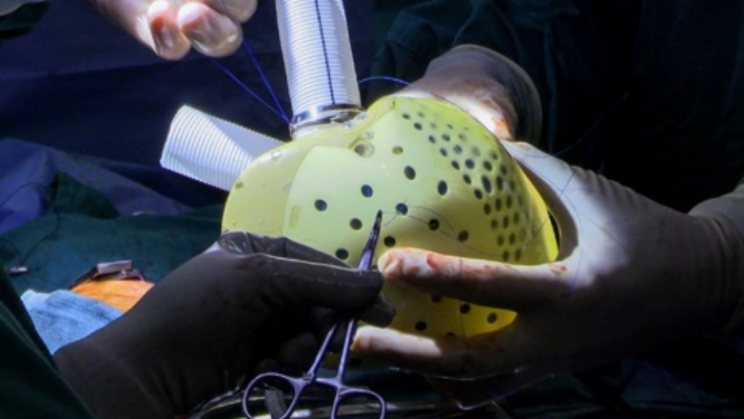
The First Robotic Heart Successfully Transplanted In the USA
Picture Source. Duke Medical School. USA.
Apro. July 20, 2021 North Carolina; USA.
The artificial heart has four chambers and runs on external power.
The surgical team at Durham, N.C.-based Duke University Hospital, recently transplanted a total artificial heart (TAH) into a 39-year-old man who experienced sudden heart failure. Unlike conventional artificial hearts, this TAH mimics the human heart and provides the recipient more independence after the surgery, the university said in a press release.
The TAH has been developed by the French company CARMAT , and consists of two ventricular chambers and four biological valves derived from bovine tissue, ensuring that the prosthetic not only resembles the human heart but also functions like one.
The recipient patient, a resident of Shallotte, North Carolina, was diagnosed with sudden heart failure at the Duke Center and had to undergo bypass surgery. As his condition quickly deteriorated, however, traditional options, including transplant, became too risky. Luckily, the Center was one of the trial sites where CARMAT is testing its artificial heart after having received primary approvals from the U.S. Food and Drug Administration (FDA) in 2020 to begin studies in the U.S. to potentially enroll 10 patients with end-stage biventricular heart failure.
The trial protocol, which the FDA signed off on, calls for an interim analysis of the first three patients after 60 days, after which the remaining seven patients will be enrolled if there are no major safety concerns, and the principal goal of the study is to determine whether the artificial heart implant is a sustainable option before transplant.
The robotic heart recipient, is now stable and being monitored at the hospital; the heart will continue to be connected to the Hospital Care Console (HCC) so that its functioning can be monitored. As part of efforts to lead a near-normal life, the recipient will have to carry around almost a nine-pound (four kgs) bag that consists of a controller and two chargeable battery packs that work for approximately four hours, before requiring recharging.
The device has already been approved for use in Europe but is only intended as a bridge to transplantation for patients who are diagnosed with end-stage biventricular heart failure and are likely to undergo a heart transplant in the next 180 days.
Importantly, the organ care system also allows transplant surgeons to measure the function of the heart before they transplant it to a recipient, allowing them to assess the organ’s viability. The system “replenishes the energy stores and you can see the heart beating,” Catarino said. “It’s not doing work, but you can measure the heart’s metabolic consumption, if it’s stressed or had coronary artery disease.”
The Duke Heart Transplant Program is globally recognized not only for its robust clinical volume but more importantly, providing outstanding quality and innovative patient care at the highest level possible. The successful implant of the CARMAT artificial heart represents the latest in a long list of accomplishments by the Duke heart transplant team aimed at further expanding the treatment options available for patients with end-stage cardiac disease.
Welcome, everyone to a new future of fully artificial technology transplantation and immune medicine research, that allows full acceptance of this type of technology in the long-term body.
Aeson by Carmat
Animation -Carmat S.A. - March 01, 2021.
Animation-Carmat S.A. - March 01, 2021.
Gustavo Ernesto Rodriguez De LiraFounder · IT Capital©
Referencias Periodísticas y de Investigación (Research References & Journal)
Printable version
The full article as published, to print or file.
Download the newsletter as PDF PDF · 0.2 MBArticle video
Play the video without leaving the site
Legal notice
This is a completely free research article, produced by a non-profit association for informational purposes only. Its distribution is authorized exclusively by IT Capital©. Any other use is not authorized by IT Capital© or its authors.